Tuesday, May 10, 2011

Amsterdam Adventures and a New Cuisine

The blog has been quiet this past week, because, as I said in the last post, my parents came to town!


 They actually just left this morning from Brussels, where we spent the last day of their stay (more on that later). We had a lot of fun, and I dutifully took notes and pictures the whole time (not really, I’m still getting used to this whole “document your thoughts and experiences” thing and I never really liked taking photographs on vacation. So bear with me if I missed some things.). Join me won’t you, for a look back at the week.

My parents flew in on a red-eye flight from JFK to Brussels, taking the train from there to Maastricht and arriving, tired but raring to go, around midday.  To help them get over their jetlag Todd and I took them for a little walk to show them the neighborhood (with an obligatory coffee and waffle break included). Our night was pretty low-key, and then the next morning we got up bright and early and headed to Amsterdam by train.

Amsterdam is one of my favorite cities; I’ve been there twice before on bus tours, once during each of my two sojourns in London. The architecture is just beautiful, the rings of canals provide a plethora of scenic vistas everywhere you go:


See the leaning houses? Click the pics to get a better view.

It is a bit difficult to get used to navigating the streets, however, especially after the calm of a small city like Maastricht. Like most large cities, Amsterdam has a lot of people in it; unlike many cities, Amsterdam also has a lot of bikers, bikers who go very fast with seemingly little regard for pedestrians who aren’t used to looking for them and so who tend to step out into a bike lane thinking it’s a sidewalk and almost get creamed.

Somehow we managed to navigate our way to our hotel (after a quick lunch break because someone (ahem) was hungry and getting cranky), which was right on the Prinsengracht canal. The hotel was spread over two different buildings, and we had two rooms at the very top of one of them, so we could look out over the rooftops of the city. We dropped our bags and right away headed out to see the sites.

Unfortunately, it was cold, windy and starting to rain. Fortunately, the national museum, the Rijksmuseum, was just a short walk away:

I'll confess I’m not a huge museum person, and when I’m in a new city, or one I don’t visit very often, I usually prefer to wander about and just soak in the atmosphere. When the weather’s not that great, however, a museum can be just the thing. I don’t know how big the collection of paintings in the Rijksmusuem normally is; the building itself is huge (and very pretty, as you can see), but it’s apparently undergoing some major renovations, so the actual part we could visit was pretty small. Which, as I said, I was fine with. We were mostly there to see the Rembrandt paintings anyway. In case you were wondering what Rembrandt looked like, here he is:

Did you know, by the way, the Rembrandt was actually his first name? I had now idea. In full he is Rembrandt Harmenszoon van Rijn. How's that for a mouthful?

After getting acquainted with Rembrandt and Vermeer and some other old Dutch painters (who are probably also very famous but I can’t remember any of them), we emerged from the museum to much brighter, though still chilly, weather. Next we walked to the Bloemenmarkt, the floating flower market which I knew my mom would get a kick out of:
The stalls line one side of a canal and rest half on the pavement, have on barges on the water. There are hundreds of types of plants, bulbs and seeds for sale:


And some other, um, products:


This is Amsterdam, after all! But the Netherlands is not only famous for its cannabis and brothels (we saw some of those too, but you can't take pictures of the girls in the windows or burly men will appear and take your camera away, apparently). When we passed a couple of cheese shops, I couldn’t resist peeking inside (and the other members of our party had no complaint, as you can see):


We bought some smoked gouda with herbs and tried many others, including bright red and green pesto varieties, which I was tempted by, but I looove both smoked gouda and cheese with herbs in it, so that flavor won.

To feel we really experienced the full range of Dutch culinary culture, we chased our cheese with frites.

There was a really big line out front of this little place tucked away in a side alley, so we knew it would be good (I love the dubious grammar and the elision of English and Dutch on the sign, don't you?). And we were right!These were some quality Belgian fries, with over a dozen different sauces available (most of them obviously mayonnaise-based, my distate for which has been documented). Mom and Dad shared a cone with Belgian mayonnaise, which is like mayo on steroids, and Todd and I experimented with the Samurai sauce, which was salmon-colored and just tasted like spicy mayo to me. The fries were amazing, though.

After wandering about for a while, watching them set up for the next day’s Liberation Day* festivities in Dam Square (May 4 is Remembrance Day, a solemn day with a moment of silence in the evening, while the next day is one of celebration with outdoor concerts and – what else? – lots of beer), we headed back to the hotel to prepare for dinner.

*That’s liberation from Nazi control during World War II, for those of you not up on your European history (don’t feel bad if you aren’t, the only reason I knew it was Liberation Day was because the university where Todd is working during his sabbatical is on holiday that day.)

Dinner, let me just say now, was fantastic. We went to this place:

an Indonesian restaurant in Rembrandtsplein called Indrapura, which had been recommended to Todd by someone he knows who is actually from Indonesia, so you know to trust him. I don’t often get a chance to eat at an ethnic restaurant that is totally unfamiliar to me, but I’d never had Indonesian before. It was different from anything I’ve ever eaten, but if I had to compare it to another cuisine I’d probably say a cross between Thai and Chinese, which I guess makes sense considering where Indonesia is located. This is a very common ethnic food in the Netherlands due the two nations' former colonial relations. I was intrigued from the moment we walked inside, especially considering their choice of front-of-house decoration:
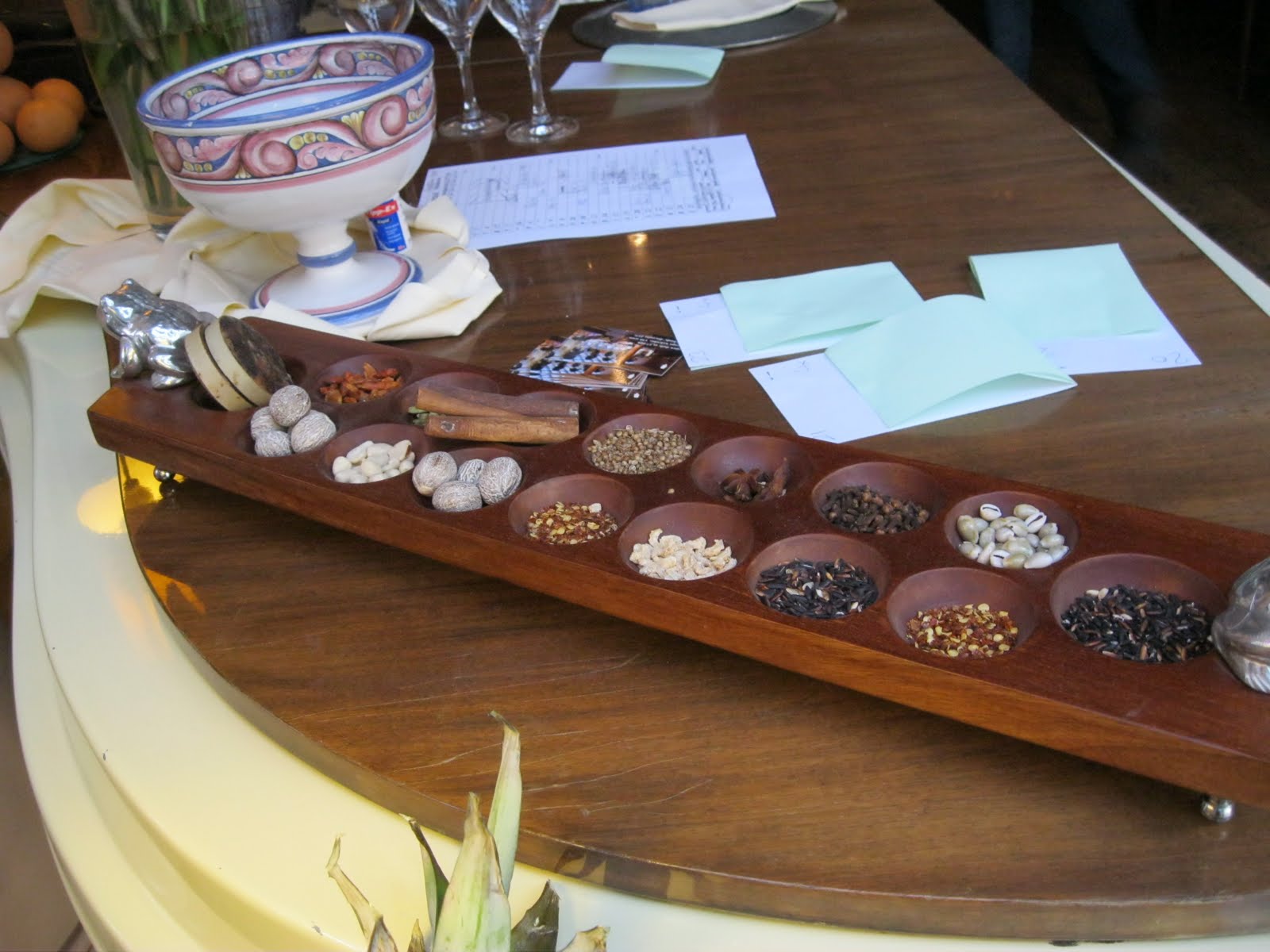
A dish of various seeds and spices

And another of fruits and vegetables that were clearly just picked up from the supermarket. The beans and asparagus are still in their packaging, and you can see a sticker on that mango and an apple. A lot of people might have been put off by this, but for some reason I was delighted.

I still feel a little weird taking pictures in restaurants, so I only have a few photos, but I managed to capture all of our dishes pretty well. You can order a la carte, but the most popular way to go at an Indonesian restaurant, at least when you’re dining with others, is to order a rijstaffel or “rice table”: basically a lot (and I mean A LOT) of little dishes that you all share, placed on a few burners in the middle of the table. It was a little complicated shuffling around all those tiny dishes (there was barely room on the table), but we developed a strategy that worked pretty well: anything that came with four individual servings, like the sesame balls, we divided up between us right away and stacked the empty dishes in a corner of the table, freeing up some space for the dishes like rice and stir-fries that had to be ladled out as the meal progressed.

First, though, the starter: spring rolls, or lumpia, a popular street food in the Netherlands:


These were pretty standard vegetable spring rolls (our meal was entirely vegetarian, due to the preferences of Todd and my mom), but very well prepared, with a sweet-and-sour dipping sauce and some pickled vegetables.

Next came the rijstaffel. We'll do this in two shots. First, one side of the table (as always, click to enlarge any picture):


Ok, we'll do this systematically, starting from the left. First up is a fried tofu dish, next to that on the bottom a baked tofu dish, both not on the menu (as far as I could tell), both dressed in the sweet soy sauce I was first introduced to in Maastricht and which I have posted about before. Above the baked tofu you see what I believe is the tumis harian, the seasonal vegetable stir-fry, which here meant snap peas (this wasn't my favorite dish. It wasn't bad, just not very exciting.). Immediately next to the snap peas is kentang balado, or spicy fried potatoes (these were also not my favorite, being mushy instead of crispy as I think fried potatoes should be, and not very spicy or flavorful). Below those you have gado-gado, vegetables in a thick peanut sauce, almost the consistency of pure peanut butter, with crunchy wafers on top called emping, or melinjo-nut chips (I have no idea what a melinjo is, but I think that is what these were. They were actually listed as a separate dish on the menu, but I didn't see anything that could have been them except for on these vegetables.). My mom didn't really like this dish, but I, being a peanut butter fiend, loved it. Next to that on the other burner is pepesan jamur, or mushrooms in banana leaf, kind of like an Indonesian tamale. Not great, I thought, but an interesting preparation. Below that are two things also not on the menu, a sesame ball like the kind you'd get at a Chinese buffet (except really good) and some sort of fried thing that was clearly meant to resemble a meatball in taste and texture, though what it was exactly I have no idea. Delicious though. Finally, above the tamales you can see some little brown balls, which are the pergedel jagung, or corn fritters, and pisang goreng, fried bananas (both very yummy, as you'd expect from anything fried so expertly) as well as a dish that you can actually see better in the next photo, so we'll move on. (Oh, and on the other side of my plate from the sesame balls you can just barely see a dish of pickled cucumbers [acar ketimun], which were on the sweet side, and, unseen in the pics, another dish of the same yellow, more savory pickled vegetables [acar campur] that came with the spring rolls and which you can see garnishing some of the other plates)


Here you can see, next to the tamales, rujak manis, or fruit salad in cane syrup (not sure what kind of fruit, maybe mango and melon?). The dish my mom is holding is asinan, I think, which would be vegetables in a sweet and spicy peanut sauce (seemed like mostly lettuce, so kind of like a slaw). On the other side of her plate there is sambal goreng tempe, or fried soy beans, and you can't see them but there were also two other dishes of little fried garnishes: sambal goreng kentang, potato sticks, and serundeng, minced coconut with peanuts that you sprinkled on other dishes to add some crunch. On the burner you have the final dishes: sayur ladeh, vegetables in coconut broth (my dad didn't like this one much), and next to that two egg dishes. At the top is halved hard-boiled eggs in a thick almost grainy sauce (sambal goreng telor), on the bottom you have a dish of tofu and scrambled egg in sweet soy sauce (tahu telor). Last but not least, there's sate tahu, fried skewered tofu with a sweet peanut sauce.*

*Sate, like lumpia, has become an integrated part of Dutch food culture as a popular street snack, and is also sold in restaurants. Saturday night we ate at a little place in Maastricht that specialized in them. They can be made of various types of meat (or tofu) and either grilled or fried, but they are almost always served with "satesaus," or sweet peanut-based sauce.

So that's it: our Indonesian feast. All the dishes were tiny, but there were so many other them we were stuffed to the gills and couldn't even think about dessert. Worn out after all that walking and delicious food, we caught the second half of the Champions' League game at a nearby pub and then stumbled back to our hotel and bed. Stay tuned for Day Two of our Amsterdam adventure!

Note: Indrapura has a website (www.indrapura.nl) with an English-language option, but the menus on the site (or at least the vegetarian rijstaffel menu) do not seem to correspond with what is actually served in the restaurant (you get a lot more than the site says you do). Actually, as noted above, the written menu we were handed did not entirely correspond to our meal. The above description was compiled partly from the online menu, partly from a (very difficult to read and so not posted) picture of the menu I took in the restaurant's window, and partly from online research (thank you yet again Wikipedia, you almost never fail me!).


Tuesday, May 3, 2011

Homemade Dutch Pancakes


Or not.

On another note: my parents arrive in Maastricht today! They'll be here for a week, during which time we will spend a couple of days in Amsterdam and one in Bruges, and I will attempt to run my first marathon (God help me...). Lots of posts and pictures (hopefully with some exciting meals and discoveries) will be forthcoming!

Monday, May 2, 2011

A French Fry Rant


Yesterday’s post was all about the Queen’s Day festivities here in Maastricht, which included, besides the flea market and various street performances, a free concert at the Stadtpark. While the grassy spaces in front of the stages were left open for people to hang out and picnic, all around the perimeter of the fenced in concert area where trucks set up to sell street food, with folding tables and picnic benches nearby for people to park themselves at and eat either sitting down or standing up.

As restaurants in Maastricht are so expensive, fast food and takeaway joints provide a good (but not necessarily healthy) option if you want a quick, cheap bite to eat. And as at the concert, a lot of places, even the carts and trucks that set up pretty much every day in the Markt, will provide outdoor seating or at least tables where customers can relax for a bit to eat their greasy snack.

Dutch and Belgian street food (and many other food items, for that matter) tend to be very similar, which makes sense considering how close the two countries are (I can run to the Belgian border in about 15 minutes, to give you an idea). The fast food of both nations (and we’re talking local fast food here, not the ever-present McDonald’s, Burger King and KFC, which I assume most readers are already familiar with) primarily consists of, besides the famous waffles, things that have been deep-fried. This includes fish (kibbeling if it’s in chunks, lekkerbek for a fried filet like you’d get with British fish and chips) with tartar sauce, a hot dog-type thing called a frikandel, and little breaded meat and/or cheese balls called kroket or bitterballen (also popular bar snacks). Indonesian foods. But probably the most ubiquitous and well-known of the Dutch/Belgian fried foods go by the name of frites (in Flemish or French) or frieten (in Dutch), a.k.a French fries (or chips if you’re British).

Credit for the invention of the classic French fry is often awarded to the Belgians, and throughout Belgium and the Netherlands you can find them on offer at informal eateries usually conveniently located on the main squares, and generally intended more for takeaway than as sit-down places (though as mentioned above most have some sort of indoor and/or outdoor seating area). These are called either friteries in French or frituur in Dutch, and usually offer a range of other fried items (mostly meat) besides French fries. Here's some examples:


A note about this place, called FEBO: this is a fast food chain that can be found all over the Netherlands. While you can order fries, drinks and sometimes soft-serve ice cream at the counter, the restaurant is also what is known here as an automatiek, similar to an automat in the States. Those of you who weren't around in the first half of the 20th century or who don't read obsessively about food (ahem) might not know what an automat is, but apparently they were really popular in the U.S. for a while, especially the Horn & Hardart franchise, the most prominent chain, which closed its last store in 1991. They're basically like a restaurant in a vending machine: you walked up to a wall of windows, put some coins in a slot, and lifted the window of your choosing to reveal your meal, which has been backloaded by workers in a kitchen behind the wall. While the rise of the suburbs and fast food chains in the States led the automats to fall out of popularity, in the Netherlands the concept survives with FEBO, where besides counter service you can choose from an array of burgers, sandwiches, krokets and frikandellen from the vending windows. Just something I thought was cool and might invoke some nostalgia for any people who may have ever experienced the automat in the States.


Can you see the fries piled up behind the guy at the FEBO counter (who was really amused that I was taking pictures, by the way)? Dutch frieten are twice-fried as classic French fries should be, once in big batches to partially cook them, and then again when the customer orders in small batches until they're nice and hot and crispy.

Belgian or Dutch frieten are a bit different from the ones you’d get a McDonald’s or Burger King; they are closer to British “chips” in that they are rather thickly cut, making them excellent vehicles for the various sauces normally available at the friteries. Now, as Todd will tell you (I’ve complained about this numerous times since arriving here), I take issue with the classic Dutch/Belgian way of consuming fries: namely, in a paper cone or square plastic container with a huge, ice cream scoop-sized dollop of mayonnaise plopped directly on top. I’m not really a fan of mayonnaise; I don’t mind it in a sauce, like tartar sauce, or mixed into tuna or egg salad, but the taste and mouthfeel of just plain mayo kind of grosses me out. It feels like eating just pure fat, which it basically is, especially when the vehicle for its consumption is a stick of deep-fried potato. Fat on fat = not good on the tummy (or the arteries, but I’m a runner, so I don’t need to worry about that. Right? Right??).

Plus, and here’s the real turn-off for me, when you dump room-temperature (gag) mayo onto a pile of hot, fresh-from-the-bubbling-oil fries, what do you think happens? I’ll tell you what happens: the mayo absorbs the heat from the fries, while the fries absorb the moisture from the mayo. What you’re left with is warm mayo on top of soggy fries, a.k.a a goopy, fatty, icky mess. Yes, they give you a little fork to eat the fries with (isn’t that adorable? But I always start with the fork and then end up resorting to my fingers, it just feels more right to me, you know?) but it’s still a mess, and not in a good way.

So hold the mayonnaise for me; I’ll take ketchup any day. On second thought, make that curry ketchup, a mildly spiced version of the former that I love so much I would eat it with a spoon. Sure it still makes the fries go soggy pretty quickly, but if I view them as merely a way to shovel as much curry ketchup in my mouth as possible, I don’t mind so much. I might have to bring back a bottle of this stuff too, along with the Indonesian soy sauce I’ve discovered (my luggage should smell great!).

Thus ends my French fry rant. Thank you for listening.


Sunday, May 1, 2011

Forget the Royal Wedding, How About a Yard Sale?


While on Friday the rest of the world was tuning in with great excitement to the Royal Wedding, the people of Maastricht were eagerly anticipating another royal holiday. Yesterday was Queen’s Day (Koninginnedag) in the Netherlands, the annual celebration of the Queen’s birthday. First observed in August in the late 1800s (under the reign of Wilhelmina), the date changed to April 30 when Juliana took the throne in 1948. When her daughter Beatrix ascended in 1980, the date was retained even though the new Queen’s actual birthday is at the end of January, because honestly, wouldn’t you rather have a holiday in the spring when the weather’s nice?

Actually there is a practical side to celebrating this holiday during a time of year when sunny weather is more likely, and that has to do with what has come to be the traditional way for the Dutch to honor their queen: with a yard sale*. That’s right, on Queen’s Day, people are allowed to sell things on the street without a permit and without having to pay a tax; this has spawned the rise of a nationwide vrijmarkt (free market or flea market) on this day, as hundreds of people gather in public parks and squares to sell second-hand items.

* The British call a yard/garage sale a “car boot sale”; maybe because originally people sold their junk out of the back of their cars?

In Maastricht, there were a few people selling things in the Vrijthoff square, but by far the most popular spot to gather was in the park on the outskirts of the old medieval city walls, conveniently located right around the corner from our apartment. Take a look:


 Basically it’s just a lot of junk (as most yard sales are) but the scale was incredible. I couldn’t imagine actually trying to find something to buy there, it was just too overwhelming, with literally hundreds of vendors spreading out their wares on blankets or card tables and thousands more people cramming the narrow paths, jostling to get a look. It was madness, I tell you, and only minutes from my front door!

Free outdoor concerts are also an increasingly popular part of the festivities, and Friday and Saturday the Stadtpark was converted into an arena with a couple of stages, a big bouncing toy for kids, and some stands selling street food and (of course) beer.


These pics were taken in the middle of the day before things really got going and the crowds started swarming. I went back at around 5 or 6 and it was a madhouse.


This shot makes me laugh: see those posters? They're for some sort of fitness club. See what they're hanging on? A beer stall. Ah, Holland!

There were also marching bands and street musicians regaling people throughout the city:


If you look closely (trying clicking the picture to enlarge), you can see that the bus in the back isn't actually a school bus. It was at one point, but now it's a Maastricht City Tours bus. Why you would want to tour this beautiful medieval city in an ugly, ungainly yellow bus with pretty much zero visibility is beyond me, especially when they also have pretty little trams and and horse and buggy ride options for those who don't want to walk around (and really, why don't you just walk? The historical, medieval portion of the city, where I live, is maybe one square mile all together, if that.).


These guys were my favorite: an all-percussion band conducted by a guy with a whistle, they were really good, an interesting mixture of younger and older people, and they all looked like they were having a lot of fun. Caused quite a bit of a traffic jam though, as everyone had the same idea I did and stopped to listen and take a picture.

The party actually started Friday night, with the concert and live music in a lot of the bars, and continued the next afternoon and evening. The atmosphere was rather St. Patrick’s Day-esque with all the revelry and music, especially because, in the same way everyone dons something green on St. Pat’s Day in the States, here people honor the royal family (the House of Orange-Nassau) by wearing orange (sometimes in the form of crazy wigs or balloons on their heads, the less free-wheeling perhaps with an orange t-shirt).

I of course went in search of some sort of unique Dutch food item associated with this holiday, but there really isn’t anything specific. Again like St. Patrick’s Day, Queen’s Day food usually just means regular food dyed orange or with orange icing (the Albert Heijn grocery store was having a special on Fanta).


 Of course, if you’re like me and you subscribe to the belief that anything dyed a different color from the normal version tastes better, you’ll be just fine with that! Happy Queen’s Day!

Thursday, April 28, 2011

The White Gold of Holland

Visit Maastricht’s markets and food stores in the springtime, and you will be confronted with sights like this:


 That’s white asparagus (and you can see some lovely Limburg strawberries in the bottom photo, too), and I’ve mentioned its abundance at the weekly markets. It’s a specialty of the southern regions of the country, and unlike the more familiar green kind it grows underground and is harvested before reaching the surface. It is apparently kind of a big deal in foodie circles, nicknamed “white gold” because of its high market prices (this must refer to prices overseas or in places where it’s not grown in such abundance; here it’s only a bit more expensive than the green kind). I’d never seen white asparagus before arriving here and I was at first reluctant to cook with it: it’s a bit unappetizing-looking, with it’s pale color and fat stems, definitely not as pretty as the green kind. But I tried some local green asparagus last week and it was deliciously fresh and tender (I didn’t even have to peel the stalks, which with asparagus in the States you almost always have to do so they’re not chewy), and so the other day I decided to go for it and get half a kilo each of both white and green.

Well, after having tried the white, I can say that fresh, locally grown and presumably recently picked asparagus is wonderful, but it’s probably not really worth paying extra for the white kind unless you’re into the novelty value. It all tasted pretty much the same to me. I boiled it (a bit too much, I will admit, as it was a little soft; still getting the hang of this whole “cooking” thing) and served it with pasta in a creamy sauce.*

*Made, I’m a bit ashamed to admit, from a powdered mix, several packages of which I found in a kitchen drawer, leftovers from previous tenants. They’re actually pretty tasty, and they are, after all, a Dutch product. Powdered and liquid bases for sauces and soups seem to be popular here, as are bouillon cubes. So you can call it cheating if you want; I’m calling it research.

Asparagus (asperges), both white and green, is all over restaurant menus in Maastricht right now. They are a very seasonal vegetable, only harvested in the spring, and the white ones are a typical food served at Easter. Most often they’re boiled and served with Hollandaise sauce as an appetizer, with the addition of ham or eggs making it a full meal. Todd’s a vegetarian and I’m not a huge fan of eggs (and forget making a Hollandaise sauce, I wouldn’t even know where to start), so we went the pasta. It was quite delicious, especially reheated the next night with a nice hunk of goat cheese melted into the sauce:

(You can get a glimpse of the white pieces in there, though they kind of blend into the pasta. It's not a great pic, but Todd was in the middle of eating when I remembered I wanted to get a shot, and I didn't want to interrupt him a second time to get the perfect picture!)

Tis the season, so get to your nearest market and pick up a bunch of asparagus. Even if it’s not local, it will at least be seasonal and so likely to be almost as tasty as Limburgian white gold!

Wednesday, April 27, 2011

My Daily Bread


If you ever visit Maastricht (or anywhere else in the Netherlands, for that matter) one thing you will probably notice right away is that the Dutch love their bread (brood, pronounced with a short “oh” not a long “oo”). No low carb diets here: sandwiches (broodjes) of cold cuts and cheese are a prominent feature on lunch menus, and there’s practically a bakery on every corner. Which makes sense, seeing as the southern provinces of Zeeland and Limburg (where Maastricht is located) are traditionally the best grain-growing regions of the country. Bakeries typically stock the usual kinds of bread you’d find in the United States and other Western European countries: white (wittebrood), whole wheat (volkorenbrood), rye (roggebrood), etc., along with baguettes, various seeded and multigrain varieties, and rolls (and pastries of course!). You can buy just a portion of a loaf if you don’t want a whole one (very convenient for two-person households), and the baker will use a nifty machine to slice it for you at no extra cost.

I’ve made the rounds of almost every bakery within walking distance of our apartment, on both sides of the river, and I’ve tried a number of breads and sweets from a bunch of different places. I like to go to shops where it seems as if the bread is baked onsite (a lot of specialty shops that sell gourmet breads, cheeses, spreads and things outsource their loaves from a bakery, which doesn’t make them any less quality, it’s just fun to shop onsite while I have the chance. How often do you run into an actual bread bakery in the States, after all?).

Luckily I don’t have to go far; there is a bakery right next door to us called De Bisschopsmolen, “The Bishop’s Mill,” that doesn’t just make their own bread, they make their own flour for the bread as well. It’s a traditional working water mill, the oldest in the country, dating from the 7th century (I don’t think the building and mill there now are original; I think those are from the 1700s, and are definitely restored. I’m working primarily from the mill’s Dutch website translated using Google, so you never know). They get most of their grain from local farmers, and deliver some of their milled grain to the Gulpener brewery, makers of Korenwolf hamster beer!

As for their bread products, the Bishop’s Mill is distinctive because they use Kollenberger spelt, a traditional medieval grain. Their bread is soft and light and very flavorful. In addition to the typical wheat breads and rolls, they also produce specialty breads with ingredients like yogurt, nuts, honey and beer (Gulpener, of course); savory products like sausage rolls and pizza-type things (a lot of their ingredients, if not local, seem to come from Spain); and, of course, sweets like cookies, cakes, and the famous Limburg specialty, vlaai (see photo above). Vlaai translates roughly to “flan,” but it’s actually a pie, similar to an American-style pie but flatter, if that makes sense. They can be large or individually-sized, with three main varieties: fruit fillings (apricot* and cherry seem to be particularly popular) with a lattice crust sprinkled with pearl sugar; vanilla custard with a crumb topping (kruimelvlaai); or a kind of rice pudding (rijstevlaai).  

*I can recommend this one! Though the crust is a bit chewy compared to the flaky, shatter-at-the-touch of a fork quality many Americans associate with pie crust. According to The Dutch Table, this is because it’s made with a yeast dough rather than a pastry one.

These things are all available to go, of course, but there is also a little café located in the rooms between the mill itself and the retail counter where you can sit down to lunch on some of their products. I haven’t eaten there yet, but I imagine it would be pretty cool to know that what you are eating was literally produced right next door. The tourists certainly seem to enjoy it; there are often hordes of them taking tours through the mill (which apparently offers workshops as well) and eating in the café on weekends. Oh well, one of the perils of living in the heart of a medieval city, I guess.

And here’s some pictures. Enjoy!


Tuesday, April 26, 2011

Cookies for Breakfast, Literally (And Chocolate, Too!)


Today I want to talk about toast. Actually, the things you put on it. I made an interesting discovery soon after arriving in Maastricht, one that made me kind of excited, to be honest: the Dutch put sprinkles on their toast. Observe:


 Called hagelslag in Dutch and usually eaten on buttered toast for breakfast (the butter helping the sprinkles to adhere), these were invented by Gerard de Vries in 1936 for a company called Venz, and are named after hail, apparently a common weather phenomenon in the Netherlands (looking forward to that)*. The picture you see above is a box of extra puur, or extra dark, chocolade hagelslag by De Ruijter, the biggest producer of bread toppings in the country. The box says it’s at least 45% cacao, which is why it can be called chocolade; if it’s under 35% cacao, it has to be called “cacao fantasy hagelslag” (perhaps implying that it’s pretending to be chocolate. Or that it wishes it was chocolate?).

There’s plenty of variety when it comes to this stuff. Here’s part of the Jumbo supermarket’s selection (like all photos on this blog, you can click to enlarge):


 As you can see, they’ve got both dark and milk versions, as well as other flavors like fruit and aniseed (these have no chocolate in them). There are also similar products such as vlokken, or flakes, which are just what they sound like: flakes of chocolate, available in dark, milk, white and in combination. Muisjes (little mice) were actually my first introduction to this type of Dutch food (and are the oldest such product, invented in the 1800s): they’re candy-coated aniseeds and are traditionally eaten to celebrate the birth of a baby on top of a crispy bread-like thing called a beschuit, or rusk. The candy is colored: boy babies get blue and white, girls get pink and white. I had beschuit met muisjes at the Jumbo grocery store, which was offering them to customers in celebration of the opening of its 200th store (I don’t think the 200th store was the particular branch I was at, I’m not sure where it was opening). They’re actually pretty good, although I am not normally a huge fan of anise-flavored things; they gave the very plain, dry rusk a pleasant sweetness but, despite the anchoring layer of butter, tended to scatter everywhere when bitten into. So a word of warning: hagelslag and muisjes make a fun but very messy breakfast treat.

On to the next item: in a previous post I espoused the glories of Nutella, and also mentioned that stores in Maastricht stock various similar sweet, pseudo-healthy spreads (yay, alliteration!). Besides the chocolatey versions, I mentioned speculoos pasta (speculoos cookie spread). Since I am a fan of the cookies and since our jar of Nutella was running low this morning, I decided to give it a whirl. Here’s another picture in case you forgot what it looks like and don’t feel like finding that other post (I will eventually include links back to old posts when I mention them, promise!):


 Now, when I initially saw this crunchy speculoos paste on the shelf, I assumed that it was some sort of peanut or other nut butter flavored with speculoos spices, with bits of cookie mixed in. But I was wrong. Here’s the list of ingredients, translated with some difficulty (using a crappy free online translator) by yours truly:

  • Speculoos, which in turn contains:
      • Wheat flour
      • Sugar
      • Vegetable oil
      • Molasses
      • Risjmiddel which I think is either baking powder or soda
      • Soy flour
      • Salt
      • Cinnamon
  • Rapeseed (canola) oil
  • Sugar (again!)
  • Lecithin
  • Citric acid

In case you couldn’t work it out from the ingredients list, basically this is a spreadable cookie. Which would be fine, mind you, if it didn’t also say this on the side of the jar (in both Dutch and French, by the way):

Rich in unsaturated fat
Source of Omega 3
Without coloring agents
Without added flavorings

Now, that last one just doesn’t make any sense: of course they added extra stuff to it, that’s what makes it taste good and keeps it spreadable. It’s there in the ingredients, which obviously don’t simply list “speculoos.” Just literally grinding up a bunch of cookies would not produce anything close to a product meant to be spread on bread. So that’s just nonsense.

Equally nonsensical, though not perhaps from a marketing standpoint, is trying to pass this off as anything remotely good for you. I mean, come on, a source of Omega 3? From where, exactly? I never realized vegetable fat and sugar were so healthful. I believe the company behind Nutella recently got sued for this same sort of thing, branding their product as a healthy breakfast food when in reality it’s more like putting frosting on your toast. Not that I’m necessarily against that, mind you (I’ve been known to eat both frosting and Nutella straight from the jar/can), but it’s downright misleading to pretend that Nutella is as healthy as, say, peanut butter, which is what the advertisements were implying. At least Nutella does have hazelnuts and skim milk in it (listed after the sugar and hydrogenated vegetable oil, of course), which do legitimately contain some healthy fats and protein. The speculoos spread has absolutely zero nutritional value as far as I can tell.

And you know what? It’s absolutely delicious.

* As always, most information in this post is brought to you by Wikipedia. Some of it, however, comes from another blog I stumbled across recently called The Dutch Table, by a Dutch expat living in the U.S who is cooking and baking her way through the culinary repertoire of her home country. If you find any of the food-related topics I have discussed on this blog at all interesting, definitely check out The Dutch Table; as a native Limburgian, I assume this woman knows what she’s talking about, and the dishes she recreates (with recipes included) look scrumptious.